
Unit 3: Acrylic Paint
Section 1:Inquiry Question and Concept Exploration

IAcylic paint disco ball by Sarishryackart. This piece creates a 3 dimesnsional effect using color placement and gradients
Inquiry Statement:
How can I use color, shape, and line to transform a flat surface into a dynamic, three-dimensional form?
Inquiry Question Evaluation
This unit will explore how color selection, shape, and line can be utilized to add an effect of depth to an acrylic painting. I strive to learn how to create a 3-dimensional image with visual energy using layering, dynamic brush strokes, and color theory to create gradients and contrasts.
Intent sentence
I'm curious about how my brush technique contributes to creating fluidity and a dynamic effect in my piece — This connects to my goal to improve my shortcomings when using a brush.
Section 2: Connections
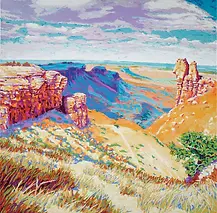


Artist: Darien Bogart
Title: Keep Moving Forward
Medium / Size: Acrylic on panel, 36″ × 36″. Darien Bogart+1
Date: 2022 (uploaded Sept. 19, 2022)
Bogart' acrylic landscape creates contrast create depth through the contrast between sunlit and shaded regions. This contrast shows the movement of the sun and the shadows it casts in the terrain.
Artist: Sari Shryack
Title: Disco Ball #6
Medium / Size: Acrylic on wood, 6″ diameter.
Sari uses a kaleidoscopic facet to manipulate light and hue to create shimmering movement. The repeating color units and subtle changes in tone create a dynamic reflection effect, which grants depth.
Vasarely uses gridlines that create an optical geometric pattern that is colored with highly contrasting colors. All to create a nice visual harmony and to achieve the effect of the spherical shape of popping out of the canvas.


When exploring acrylic painting, three artists stood out. David Bogart’s mastery of light and shadow inspired me to separate tints and tones to create depth. Sari Shyrack’s kaleidoscopic disco balls encouraged me to experiment with a wide range of colors. Finally, Victor Vasarely guided me in achieving visual harmony and entrancing optical effects. These influences were crucial in developing my piece, helping me create the illusion of depth while experimenting with color, shape, and pattern to make it visually engaging and dynamic.
Section 3: Investigate
Acrylic paint and color theory notes

My reintroduction to the color wheel and first time using acrylic colors.

One of my first instances of color blending and color testing.

Acrylic Paint
Acrylic paint is a fast-drying, water-based paint that can be used thick or thin on many surfaces. It’s versatile, vibrant, and ideal for layering, blending, and experimenting with textures.

Types of brushes

For investigating this unit, I primarily used the introductory video, which showed me the basics of acrylic painting, from what paints to use to what the different types of brushes do and when to use them. This video even showed the optimal way to set a color palette and how to work with it efficiently. In tandem with this, I also investigated the color wheel and color theory through a worksheet provided in class, which helped me become accustomed to the brushes and colors. The final piece of investigation I conducted was just experimenting with the color further and trying to make lighter tints and darker tones of colors to sort of create value scales and gradients fo my colors.
Section 4: Create
Day 1


Day 2
Day 3


Day 4

I missed the first day of this project, so I started late and had to do the first step and a part of the second step in one day. The first step was tracing a discoball image into a paper plate using a graphite stick. The second step was retracing the lines, but with acrylic paint using a color of your choice(I chose blue). The second day, I finished painting my lines blue and started coloring each square. I also made the choice not to follow a reference image. The third day, I took the Disco ball home and finished painting all the squares using complementary colors for harmony, gradients for fluidity, and Darker values for the right side of the ball for depth. As for the fourth and final day, I finished up the colors and layering and went on to recolor the lines, but in different hues as to better fit with the colors around them.
Section 5: Final Artwork

Artist: Joaquin Escalante
Title: Party Time
Size: 29 x 29 cm, area of 661c cm
Date of Completion: Nov 5, 2025
Why: Because I associate colorful things with having a blast, and since it is a disco ball, which is found in parties, I wanted to have as much fun as possible while painting an object asociated with fun
Section 6: Communicate and reflect

In retrospect, this unit was a fun experience, but up until this point in the course, I have found it my least favorite. Don't get me wrong, it has not been bad, but it hasn't been as permissive as unit 1, and it just hasn't been as rewarding as unit 2. I say this because when starting this project, I came in with the impression that I was confined to doing a disco ball, which wasn't the case, something that I learned much later in the unit. This caused me to feel limited in my creativity, as I was stuck doing a discoball, something I wasn't too excited to work on. I believe I missed the information that said I wasn't forced to do a discoball because I was absent from the first class due to a medical appointment. But, well, that was really my only complaint with this unit, as other than that, this unit was not bad, as I got more comfortable with painting using brushes, something I was really looking forward to going into this art course. Not to mention, I also gained a lot of knowledge and sensibility when picking colors and mixing them to make new tints or tones. The project definitely got better the more I worked on it. It went from a unit I was hating to one that I liked, not as much as the others, but still liked. As for my final result, I'm quite happy with it, as quite a lot of effort was spent on this discoball. I mostly feel I did a good job with the gradients between colors. However, in some parts I found it hard to blend the color, like in the middle. Furthermore, I could've painted the disco ball slightly better, as some white spots are still slightly visible. Well, I have nothing else to say about this unit other than I enjoyed it and learned quite a lot.